JP Chaney ’26 uncovers community stories through capstone project podcast
October 19, 2026
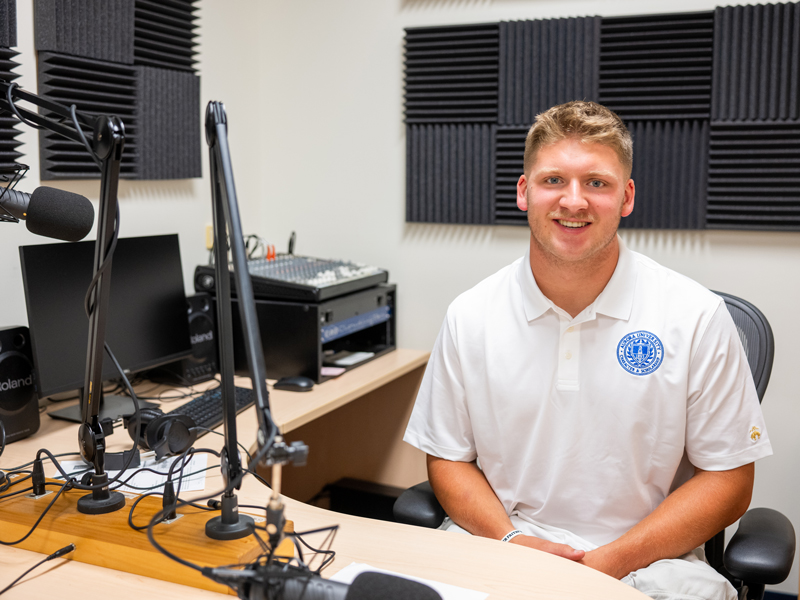
For his communication capstone project, business administration, communication, and marketing triple major Jackson (JP) Chaney ’26 created “The Bulldog Life,” a podcast dedicated to uncovering the stories, experiences, and motivations of people who made lasting impacts in his hometown of Batavia, Illinois. Drawing on skills he developed throughout his coursework, Chaney planned, recorded, edited, and produced a series of in-depth conversations that challenged him to think like a storyteller. The experience not only strengthened his technical and communication skills but also reinforced the value of listening, relationship building, and community engagement.
What inspired “The Bulldog Life” as your capstone project?
I heard about someone who sat down with people in their hometown to try to understand what made it so special, which inspired me to think about the stories that exist in every community. I knew Batavia had people whose experiences and perspectives were worth sharing, and I wanted to be the one to tell them. Given my skillset, podcasting felt like a natural fit, and I named it after Batavia High School’s mascot, the bulldog.
What was your vision for the podcast when you started?
I wanted to uncover the “why” behind people who have dedicated themselves to their communities. I wanted to know what experiences shape where they call home and what motivates them to stay. I grew up in Batavia, and I wanted to see others' passion for what I experienced.
How do you identify guests for your episodes, and was there one conversation that especially stood out?
I started with someone who knew the area better than anyone: my former football coach at Batavia High School, Dennis Piron. He connected me with my first guests, and from there, each person introduced me to someone else. It felt organic, and everyone was excited to help. Talking with Coach Piron ended up being one of the most memorable conversations and a highlight of the project. He spoke about what he wanted players to experience and build throughout his program, and I can confirm that is exactly what happened to me.
Who else have you sat down with so far, and what are the themes of your conversations?
I have interviewed nine community leaders, educators, coaches, and residents. The themes are consistent with everyone: why they chose the area, what the community has meant to their families, and what they hope never changes.
How did creating “The Bulldog Life” allow you to apply classroom knowledge to a real-world project?
My Multimedia Writing and Storytelling class taught me the technical side — recording, editing in Adobe Audition, and structuring a narrative — but the real learning came from applying those skills outside the classroom. I had to figure out how to ask questions that sparked impactful answers, how to listen instead of just waiting for my turn to talk, and how to build a series of stories that would resonate with listeners.
What were some of the most valuable lessons you learned through creating and producing a podcast?
I gained valuable experience scheduling interviews, managing multiple conversations at once, and following through on a long-term project. The biggest challenge was coordinating nine different guests around everyone’s availability and the podcast studio on campus. At one point, I also lost an entire edited episode because I didn’t save it properly, which was a difficult lesson in attention to detail.
Beyond those experiences, I learned that communication is not just about talking; it is about listening and making space for people to share their stories. I also found that service looks different for everyone, but it’s what builds communities into something special. Towns are built on people who care, and that care shows up in many ways.
Looking back, what are you most proud of, and what are your goals for continuing the podcast?
I am proud of what I was able to complete. I wanted to show a glimpse of a community, and I feel like I achieved that. I am proud of the list of people I was able to connect with.
Moving forward, I want to keep recording slowly and use it as a networking opportunity. This is a chance to meet new people in important areas. The results are less important to me — I just want to continue to connect with people.
What is your advice for students considering community-based projects?
Start with something you actually care about, something you can’t stop thinking about. Build relationships first, ask for help, and learn from people who know more than you.