Interprofessional simulation prepares AU students for real-life emergencies
June 01, 2026
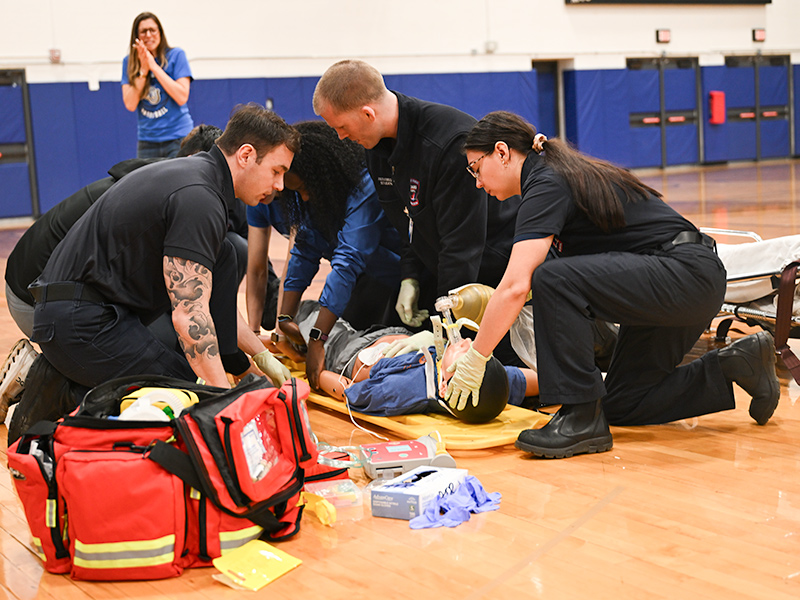
Just beyond the “Emergency Training: Simulation in Progress” signs, Aurora University Master of Science in Athletic Training (MSAT) and Bachelor of Science in Nursing students collaborated with Endeavor Health paramedic education students to provide life-saving care during spring semester. Throughout the day, four groups navigated the same patient scenario while gaining interprofessional experience for career preparation, rotating through 90-minute cardiac emergency simulations.
Setting the Scene
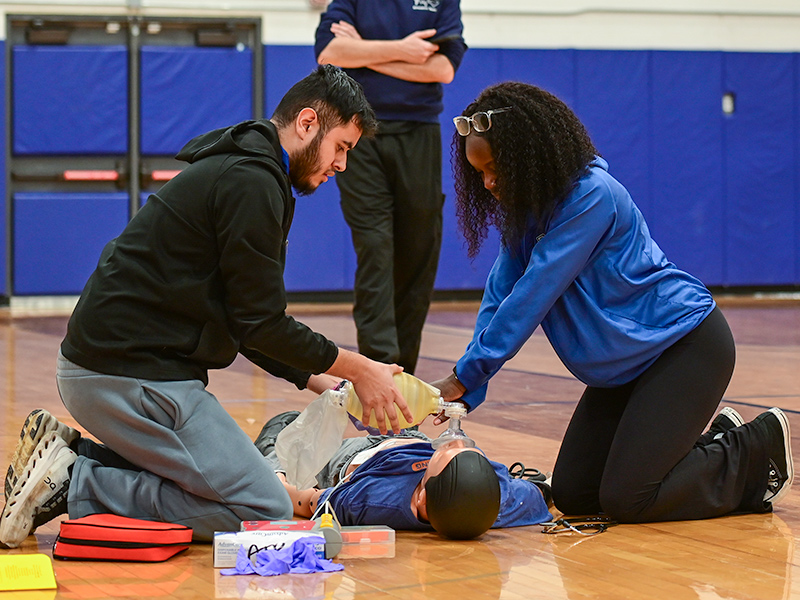
In Thornton Gymnasium, a group of athletic training students encountered a manikin on the floor; he was Christopher Black, a 65-year-old man with six children, retired from the United States Postal Service. Christopher and his wife Hazel — played by AU’s very own Jessica “JJ” Jensen, visiting senior lecturer of theatre — had traveled to AU to watch their son’s basketball game. Hazel was hesitant about the trip given her husband’s health issues, including kidney stones, chronic renal failure, and upcoming dialysis treatment. What followed was an experience faculty called a high-stakes “game of telephone” that mirrored the communication and teamwork challenges of real-life emergencies.
Preparing for the Simulation
Before simulation day, most of the participating students felt tense.
Although confident in his abilities, Eric Perez ’27 MSAT, a first-year student with one clinical rotation under his belt, called it “nerve-wracking to know I had to prepare for anything to happen.”
Students entering their final year of clinical rotations, like nursing major Malakhi Zalud ’26, echoed his sentiment, saying, “It was an emergency situation. That's all we really knew, and that unknown was the most challenging part.”
Haley Zimmerman, assistant professor of athletic training and clinical education coordinator, validated these feelings for students, saying they are “the purpose of the assignment and a reflection of how much students care about their work.”
Facing the Unknown
Despite uncertainty, groups moved quickly when the simulation began. Athletic training students addressed the patient immediately. Mariette Sogluhun ’27 MSAT explained, “We decided to approach the manikin and began asking him questions before performing CPR and calling 911,” leading to the first transition of care.
Paramedic students responded, practicing the challenges of navigating an unfamiliar building efficiently and relaying information clearly to the hospital over the phone for the second handoff.
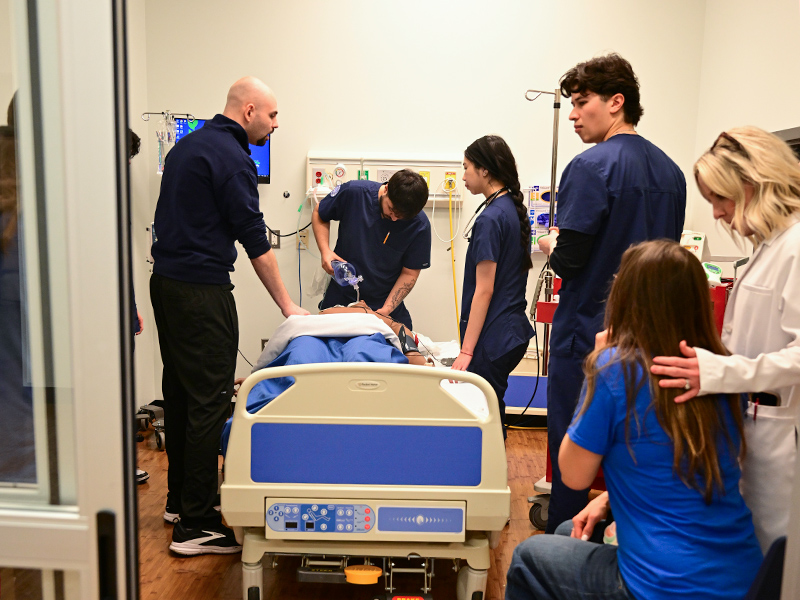
Once the patient was transported to the emergency room — the nursing simulation lab on the second floor of Alumni Hall — Nursing students administered emergency treatment, including medication and continued CPR compressions. It was their job to identify Christopher’s condition, which was cardiac arrhythmia caused by electrolyte imbalance, according to the faculty. Each group practiced de-escalation tactics with Hazel, who was present and emotional during each phase of care.
Including an actress as Christopher’s wife proved to be one of the most memorable components of the event, providing lessons on adaptability. “We thought that was going to be a really important piece to give the students the full perspective, and it ended up being one of the greater parts of the day,” said Kerry Vaccaro, director of skills and simulation center and assistant professor of nursing.
Recalling the surprise element, nursing major Tyler Mella ’26 admitted, “We didn’t anticipate her being there. We had to comfort her, make sure we addressed her, and role switch.”
Similarly, nursing major Alexandra Pope ’26 learned that “sometimes you have to pick up different roles, or you just fall into one.” Being closest to the door in the hospital room, Pope had to respond to Hazel quickly when she entered the hospital room, ensuring the concerned wife received the information she deserved.
Reflecting on the Experience
All four simulations concluded with a debrief where students and faculty reviewed the experience, acknowledging important factors like delegation, prioritization, and environmental implications. Each group consistently identified teamwork as a key skill developed.
Vaccaro noted, “If your own discipline is not working well as a cohesive team, then you’re going to have delays in care. And really, those impacts were the same, whether it was athletic training, paramedics, or nursing.” Zimmerman elaborated, “Healthcare is very team-based, so this kind of comprehensive collaboration provides students with a true snapshot of their career.”
Students also emphasized the impact of communication skills, especially during transitions. Athletic training students shared the difficulty of conveying the scene with specificity and efficiency to dispatch, while nursing students emphasized their struggle in finding the right words to comfort Hazel. Zimmerman recalled that one simulation group found inconsistencies with the amount of CPR compressions that were reported to the paramedics and the hospital versus the number of cycles actually performed. For her, “That’s why reflection is so important and puts students in a position of growth and learning.”
Participants identified and appreciated the importance of this collaborative dynamic. “What stood out the most was seeing how everyone else performed their roles. We do not always get to see what nurses or paramedics do behind the scenes, so watching them in action was really interesting,” said Sogluhun. “It was so interesting to learn the similarities and differences each group has when providing care for the same patient,” Perez echoed.
To provide perspective across disciplines, Pope highlighted how each group’s response occurred during different phases of the emergency. “I think as nursing students, we’re focused on how patients are in the hospital, so it was interesting to understand the process before they arrive to us.”
A Culture of Collaboration
Vaccaro credits faculty dedication for making the event possible. “I wouldn’t be able to pull off anything like this without the support of the faculty. It’s the faculty looking at innovative ways to teach students that led to the collaboration," she explained. “It fits with the mission and vision of Aurora University. We’re not just doing it for this one moment in their life. We want to transform their learning” — and her own, as she also gained new insights through the simulation, despite having been a nurse for over twenty years.
Zimmerman values giving students opportunities to practice their disciplines in a safe space. In class, she often takes on the role of a patient in front of her students, showing a range of emotions and reactions, to model an adaptive, patient-centered approach to care, a method that carried into the simulation as her students communicated with Hazel. For Zimmerman, interprofessional simulations provide more robust exposure to emergency situations, ensuring students “are prepared for the unpredictability of their clinical and professional experiences.” She described their progression from in-class role play to comprehensive simulations and eventually their careers as “fun to watch.”
In the end, Christopher’s vitals appeared on the screen near his hospital bed, signaling a successful return of spontaneous circulation during each simulation. Amid relief and celebration, faculty recall that students “left energized” and “wanting more,” which is the plan for both programs. What began four years ago as a smaller initiative within the athletic training department has since grown into a key component of both athletic training and nursing curricula, with goals to expand the collaboration even further.